
From Sharpville to Boardroom:
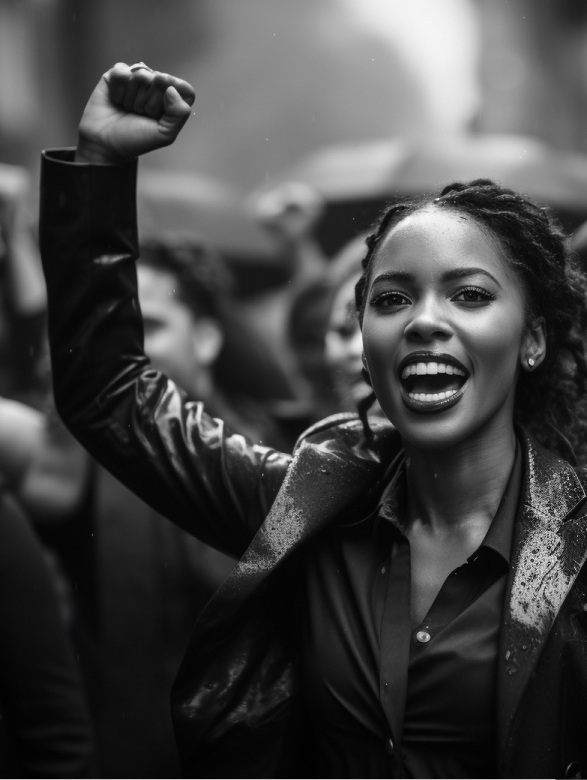
Why women’s equality strengthens democracy
WORDS BY Phakamile Hlubi-Majola: Activist and former journalist
March is a month of remembrance and resolve. On International Women’s Day, we honour the struggles and achievements of women across the globe, and on Human Rights Day, we honour the victims of the Sharpeville massacre of 1960, when peaceful protestors against Apartheid’s pass laws were met with brutal violence. These commemorations are intertwined. They remind us that the fight for dignity, equality, and justice is ongoing. Both days reflect a principle that must guide us still: women’s rights are workers’ rights, and workers’ rights are human rights – inseparable, indivisible, and essential to justice.
THE LEGACY OF WOMEN IN THE STRUGGLE
Under Apartheid, Black women bore the brunt of triple oppression, namely, race, gender, and class, yet they stood at the forefront of resistance. South Africa has a rich history of women who risked their lives for genuine freedom. Courageous women like Winnie Madikizela-Mandela, who mobilised communities and became a symbol of resilience when many leaders of the liberation movement were jailed or exiled. Fatima Meer, a fearless activist, who endured imprisonment, banning, and assassination attempts. Ruth First, an academic and radical journalist who used investigative journalism to expose the atrocities of the Apartheid government. She was detained under solitary confinement and later assassinated in Mozambique.
These women fought not only for themselves, but for the freedom of all South Africans. Their courage laid the foundation for the rights we enjoy today.
REFUSING TO ACCEPT INEQUALITY
Angela Davis once declared: “I am no longer accepting the things I cannot change. I am changing the things I cannot accept.” This philosophy of resistance reminds us that women have never been passive recipients of history. From the streets of Sharpeville to the corridors of power today, women have stood at the forefront of change, refusing to accept injustice as inevitable. Ruth First, Winnie Mandela, Fatima Meer and countless others embodied Davis’s words long before they were spoken.
They refused exclusion from leadership and silence in the face of brutality. They changed the things they could not accept and gave real meaning to freedom.
PROGRESS AND PERSISTENT BARRIERS
Since 1994, women have made significant strides in politics and the workplace. Yet full equality remains elusive. Issues like the gender pay gap, glass ceilings, and workplace harassment persist. Representation is uneven: while public sector leadership has reached around 43–44% female representation, the private sector lags behind. Women make up just 25.3% of top management and 35.8% of senior management roles, with Black women significantly under-represented, despite women comprising over 45% of the workforce. As of December 2025, only five of the forty CEOs (12.5%) in the Top 40 JSE listed companies were women.
The gains from the battle for equality in the workplace should not be viewed as a charitable act, by a benevolent employer. The process to achieve these benefits came at a huge cost. This also demonstrates the continuation of a struggle that began in the streets and now extends into boardrooms, and into all aspects of our society.
South Africa has progressive legislation in the form of the Employment Equity Act, gender representation targets, and maternity protections, to name but a few examples, but legislation alone cannot dismantle structural inequality. Gender-based violence remains alarmingly high, pay gaps persist, and barriers to advancement, particularly for black women, endure. Activism, vigilance, and solidarity are required to ensure that rights on paper translate into rights in practice.
WHY EQUALITY AND DIVERSITY MATTER
Equality is more than just moral imperative – it is a strategic advantage. Evidence shows that diverse workplaces boost productivity, innovation, and profitability. When women earn an income, families are strengthened, poverty is reduced, and education outcomes improve.
Equal workplaces also model democratic values of fairness, representation, and accountability. A society that excludes women from leadership undermines its own democratic foundations. Simply put: when women participate fully, economies thrive and democracies deepen.
DIVERSITY AS SOUTH AFRICA’S COMPETITIVE EDGE
Just as women resisted state sponsored exclusion during the struggle against Apartheid, today we must resist exclusion in our workplaces. A diverse workplace is a powerful advantage. Companies that embrace diversity and racial transformation gain resilience, innovation, and a competitive edge. Those who claim otherwise echo the same divisive lies that once justified Apartheid.
We must reject this false narrative, because the facts show the opposite: diversity strengthens business, strengthens democracy, and strengthens our nation.
South Africans carry a greater responsibility to prove that diversity is not only possible, but profitable and essential to rebuilding a country scarred by brutal divisions. Diversity is our competitive edge, not our weakness. Together, we must refuse to be dragged back into the past by those who spread lies and seek to divide us.
THE CALL TO ACTION
As South Africans, we must ensure that our workplaces reflect the values of our Constitution. Employers must commit to equity, unions must defend women’s rights as workers’ rights, and men must stand as allies, not gatekeepers.
The struggle continues, but so too does our resolve. From Sharpeville to the boardroom, the message is clear: when women rise, democracy rises with them.
This article has been written by Phakamile Hlubi-Majola, a former journalist and the CEO of Blaqstar Kreativ, a boutique PR & Communications Company.